
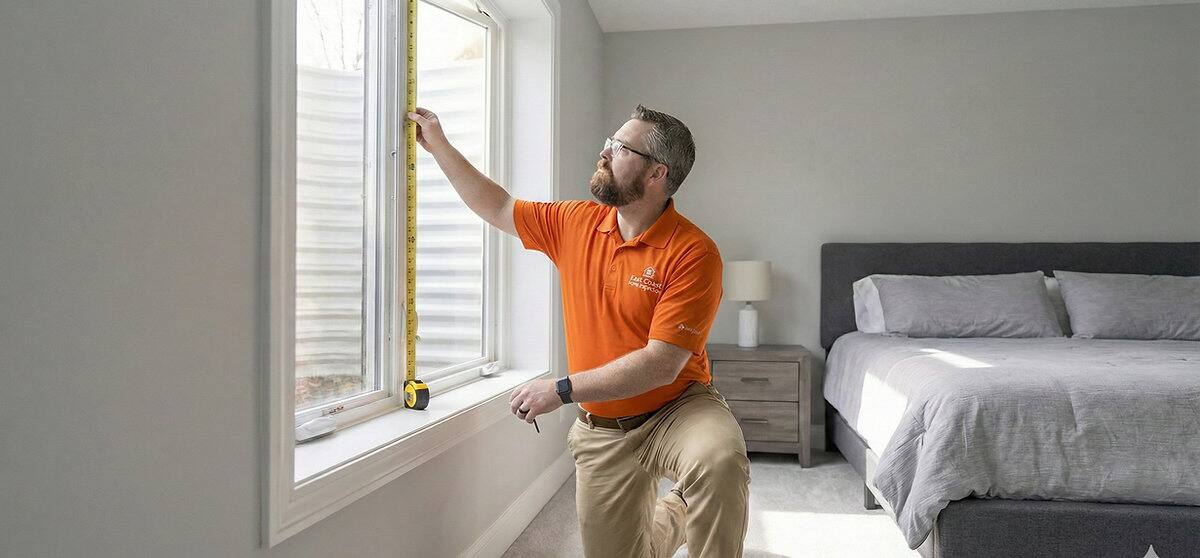
How to spot non-compliant bedroom windows during showings and protect your investment before you make an offer.
Quick Answer
The National Building Code of Canada requires every bedroom to have an emergency exit window with a minimum 3.8 square feet of unobstructed opening. Roughly 30% of homes I inspect in Southern NB have at least one bedroom that does not meet this requirement. Correcting a non compliant window typically costs $2,000 to $4,000 per window.
Why This Matters
In over 10 years inspecting homes across Southern New Brunswick, I’ve completed thousands of inspections in Saint John, Hampton, Rothesay, Quispamsis, Sussex, and Grand Bay-Westfield.
Here’s what surprises most buyers: approximately 30% of the properties I inspect have at least one bedroom with windows that don’t meet egress requirements.
If you’re viewing 10 homes this month, roughly 3 of them have a safety issue most buyers won’t catch until it’s too late. Most people haven’t heard the term “egress window” until their home inspection report. By then, they’re already emotionally invested and facing an unexpected safety concern that could cost thousands to correct.
What Is an Egress Window?
An egress window is a bedroom window specifically designed to serve as an emergency exit in case of fire or other emergency. It is not just any window in a bedroom, it is a window that meets specific size, accessibility, and operation requirements under the National Building Code of Canada.
When you are buying a home, egress windows are one of the most commonly overlooked safety features. Many sellers, real estate agents, and even some inspectors will miss them entirely. Home buyers often do not discover egress window violations until after they have made an offer or completed their home inspection.
To be compliant, an egress window must meet these basic requirements:
- Large enough to provide a safe emergency exit (minimum 3.8 square feet of opening)
- Easy to open by anyone in the home, including children and elderly people
- Low enough to the floor that a person can exit without climbing (maximum sill height 44 inches)
- Unobstructed, with no furniture, bars, or security bars blocking the opening
Why Egress Windows Matter
When I explain egress requirements to buyers during home inspections, I put it simply: if there is a fire and the hallway is blocked, can everyone get out through the bedroom window? To be compliant, an egress window must be large enough to provide a safe emergency exit (minimum 3.8 square feet of opening), easy to open by anyone in the home including children and elderly people, low enough to the floor that a person can exit without climbing (maximum sill height 44 inches), and unobstructed with no furniture, bars, or security bars blocking the opening.
What Are the Egress Window Requirements in Canada?
The National Building Code of Canada (NBC 2020) sets specific requirements for egress windows in Part 9, Section 9.9.10. These requirements apply to all residential bedrooms across Canada, including New Brunswick. The Government of New Brunswick Building Inspection Services enforces these standards through local building permits and inspections.
What this means in practical terms: the opening must be at least 15 inches in both height and width, and the total area must be at least 3.8 square feet. You cannot have a window that is 10 inches wide by 6 feet tall because the width does not meet the 15-inch minimum.
The sill height requirement is equally important. If the window sill is more than 44 inches above the floor, it becomes very difficult for a child or elderly person to escape through the window in an emergency. I discuss the National Building Code requirements and local compliance in my guide to home inspections in New Brunswick, where code compliance is a core part of every assessment.
How to Check Egress Windows During Your Home Showing
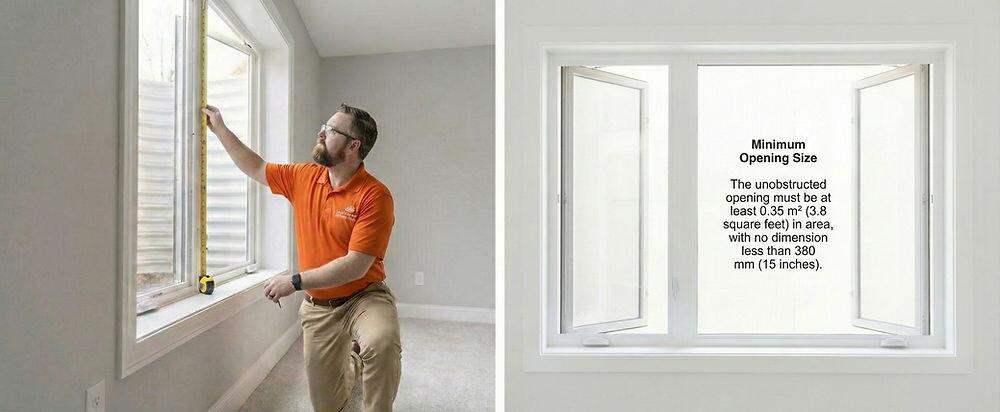
Here’s my practical checklist for buyers viewing homes in the Saint John area. You can do this during any showing without special tools:
-
Step 01
Identify All Sleeping Rooms
Walk through the home and identify all rooms currently used as bedrooms, basement rooms that could be bedrooms (rec rooms with closets, finished spaces advertised as "potential bedroom"), and any room where someone might reasonably sleep.
-
Step 02
Measure the Window Opening
You don't need precise measurements during a showing. Use your hand span (most adults have 8 to 9 inches from thumb to pinky). If the window opening is less than two hand spans wide or tall (about 15 inches), it likely fails. The "shoulder test": could you fit your shoulders through that opening? Could an average sized adult escape through it?
-
Step 03
Check the Sill Height
Stand in the room and look at the window sill height. Is it chest-height or lower? Likely compliant. Is it above your head when standing? Likely too high (exceeds the 44-inch maximum).
-
Step 04
Try Opening the Window
Actually open the window during your showing. Does it open easily without keys or tools? Does the window stay open on its own, or does it need a prop? When fully open, is there clear space to climb through, or does the window sash block the opening?
-
Step 05
Look for Red Flags
Based on thousands of inspections across Hampton, Saint John, and surrounding areas, watch for casement windows with centre hinges, awning windows, small slider windows, and multiple small windows instead of one large one.
Common Red Flags I Find Throughout Southern NB
How to Calculate Window Opening Size
If you want to be precise during your showing, here’s the simple math:
Example 1: Window opens to 19” wide × 22” high
19 × 22 = 418 square inches. 418 ÷ 144 = 2.90 square feet.
FAILS: less than 3.8 sq ft required.
Example 2: Window opens to 20” wide × 30” high
20 × 30 = 600 square inches. 600 ÷ 144 = 4.17 square feet.
PASSES: exceeds 3.8 sq ft required.
What Questions Should You Ask During Showings?
Have the basement windows been replaced or modified in the past 10 years?
If the home has a finished basement with bedrooms, ask the seller whether any windows have been replaced. If windows were replaced without proper permits or without considering egress requirements, they may not meet current code. The original windows may have been compliant, but newer windows installed during renovations might not be.
Were permits obtained for the basement renovation?
A finished basement bedroom must meet current egress requirements under the National Building Code. If the renovation was completed without a building permit, there is a higher risk that egress windows were not properly installed or verified. In New Brunswick, you can contact your local building inspector to verify whether permits were issued for the property.
Are the basement bedrooms legally designated as bedrooms?
Ask the seller whether the basement rooms are legally designated as bedrooms. If they are not, they do not technically require egress windows. However, if there is a bed in the room and a door that closes, an inspector will likely consider it a sleeping room and require egress compliance. This is an area where I recommend getting clarity in writing from the seller before making an offer.
Can I open these windows easily without removing bars or furniture?
If you see security bars, burglar bars, or furniture blocking any window in a bedroom, ask whether they can be removed. Security bars that are permanently installed may violate egress requirements, even if the window opening is the correct size.
What Happens When Your Inspection Finds Egress Violations?
If your home inspector identifies egress window violations in the inspection report, you have several options. According to Canada Mortgage and Housing Corporation guidance, egress violations are a material defect that must be disclosed and addressed before or after closing.
Your Options as a Buyer
-
Option 01
Request that the seller correct the violation before closing
You can negotiate a condition into your purchase agreement that requires the seller to install compliant egress windows before you take possession. This typically costs $2,000 to $4,000 per window in the Saint John area.
-
Option 02
Negotiate a price reduction
Instead of having the seller fix the windows, you can negotiate a credit or price reduction to cover the cost of correction. This gives you control over the contractor and timeline for repairs.
-
Option 03
Accept the violation as is
You can choose to accept the home with the violation and plan to fix it yourself after closing. This is the riskiest option because you become responsible for the cost and any liability if the violation causes a safety issue.
-
Option 04
Walk away from the deal
If the cost of correction is too high or you are uncomfortable with the safety risk, you can withdraw your offer. This is always an option if you are still in the inspection period.
Most buyers choose either to request that the seller correct the violation or to negotiate a price reduction. The best option depends on the overall condition of the home, the market conditions, and your comfort level with unexpected repairs. I help buyers understand all these options in my post closing guide.
Practical Advice for Home Buyers in Southern New Brunswick
During Your House Search
As you are browsing listings online, pay attention to basement bedrooms and bedrooms in older homes. If you see a listing with a finished basement bedroom, there is a higher risk of egress window violations. You can ask your real estate agent to ask the seller for documentation of any basement renovations, permits, and window replacements.
During Showings
Use the five step checking process described earlier to assess each bedroom. If you notice potential violations, do not immediately rule out the home. Instead, make a note and plan to ask more detailed questions during your second or third showing. Many buyers will not notice egress violations at all, so you already have an advantage by knowing what to look for.
Before Making an Offer
Action steps before you make an offer:
- Ask your real estate agent about any basement renovations or window replacements.
- Request documentation of building permits for any renovations.
- Specifically request a pre inspection walk through to assess bedroom windows.
- Include a home inspection contingency in your purchase agreement so you can address any violations before closing.
- Consult with your home inspector about the specific egress windows in the home you are considering.
Knowledge about egress window requirements protects your investment and ensures the safety of your family. Egress window violations are not rare in Southern New Brunswick, but they are often fixable if you catch them early in the buying process. I address egress windows in every home inspection I complete, and I have developed a detailed guide to common issues found in older Southern NB homes that includes egress window troubleshooting.
Knowledge Protects Your Investment and Your Family
Egress window violations are among the most common safety deficiencies I find during home inspections in Southern New Brunswick. With approximately 30% of properties showing some level of non-compliance, this isn’t a rare issue, it’s something every home buyer should understand and check.
The good news: armed with this knowledge, you can identify potential problems during home showings, ask informed questions, and make better decisions about which homes to pursue.
Whether you’re looking at a charming 1970s bungalow in Rothesay, a renovated home in Saint John’s north end, or a newer property in Quispamsis, taking a few minutes to check bedroom windows could save you thousands of dollars and ensure your family’s safety.
Remember: egress requirements exist because they save lives. A window that meets code requirements today could be the exit that saves your family in an emergency tomorrow.
Frequently Asked Questions About Egress Windows in NB
What size does an egress window need to be in New Brunswick?
The National Building Code of Canada requires a minimum opening of 3.8 square feet (0.35 m²), with no dimension less than 15 inches (380 mm). This means both the height and width must be at least 15 inches. The window sill must not be more than 44 inches (1,118 mm) above the floor. Windows smaller than these dimensions do not meet egress requirements.
Do all bedrooms in New Brunswick need egress windows?
Yes. The National Building Code of Canada requires all sleeping rooms to have operable windows that meet egress requirements. This applies to every bedroom in the home, including basement bedrooms. If a room is designed or used as a bedroom, it must have a compliant egress window. If a room does not have a closet and is not designed as a bedroom, it may not require an egress window.
How can I tell if a basement window meets egress requirements during a showing?
Use the “shoulder test” to estimate whether the window width is at least 15 inches. Check the sill height to ensure you can open the window without climbing. Try opening the window fully to confirm it operates easily and is not blocked by furniture or bars. Finally, measure the approximate opening height and width to calculate if the total area exceeds 3.8 square feet.
How much does it cost to fix an egress window violation in New Brunswick?
The cost to correct a non compliant basement window typically ranges from $2,000 to $4,000 per window in the Saint John area. Costs vary depending on whether the window well needs to be enlarged, whether the sill needs to be lowered, and whether new framing is required. Get quotes from local contractors before negotiating with the seller.
What happens if a home inspection finds egress window violations?
If your home inspector finds egress window violations, you have four options: request the seller correct the violation before closing, negotiate a price reduction, accept the violation and plan to fix it yourself, or walk away from the deal. Most buyers choose to request correction or negotiate a credit. Make sure your purchase agreement includes a home inspection contingency so you can address violations before closing.