
C-NRPP Certified
Canadian National Radon Proficiency Program certified.
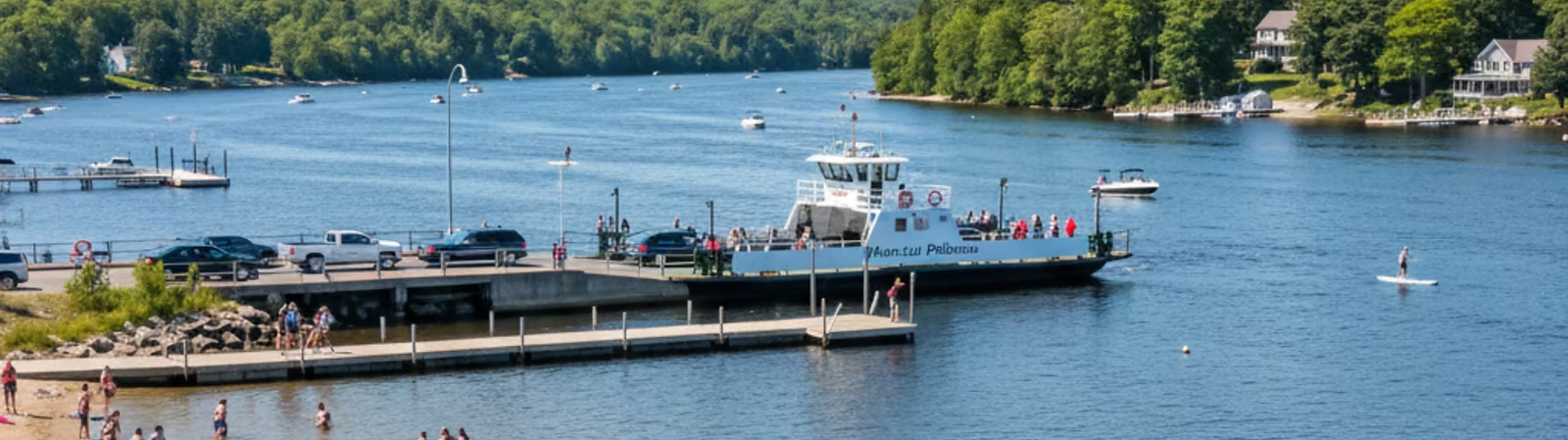
Service Areas · Grand Bay-Westfield
Expert inspections for waterfront homes, cottage conversions, and rural properties along the Saint John River.
Certified and Trusted in Grand Bay-Westfield

Proud member of the Saint John Regional Chamber of Commerce.

Registered Home Inspector, nationally recognised designation.

Wood Energy Technology Transfer certified inspector.
Canadian National Radon Proficiency Program certified.
Grand Bay-Westfield stretches along the Saint John River from the Grand Bay village core to the historic Westfield Beach and beyond, a community built on the tradition of river cottages, summer estates, and the families who eventually made them home year-round. Formed in 1998 through the amalgamation of the Town of Grand Bay and the Village of Westfield, the municipality brings together more than a dozen distinct communities. With approximately 5,000 residents and 2,000 dwellings, this is a community where no two inspections are the same.
What makes Grand Bay-Westfield unique from an inspection perspective is the sheer diversity of housing stock. Roughly 40% of homes were built during the 1960s and 1970s suburban expansion, but a significant portion dates back much further, to the early 1900s cottage era when Saint John families built seasonal retreats along the river by rail. Many of those cottages have been converted to year-round homes, and the quality of those conversions varies enormously. Every property relies on a private well for drinking water, and over half use on-site septic systems. A thorough home inspection isn't optional here. It's essential.
From Westfield Beach cottage conversions to newer builds in Nerepis, here is a look at some of the homes I have recently inspected in Grand Bay-Westfield.
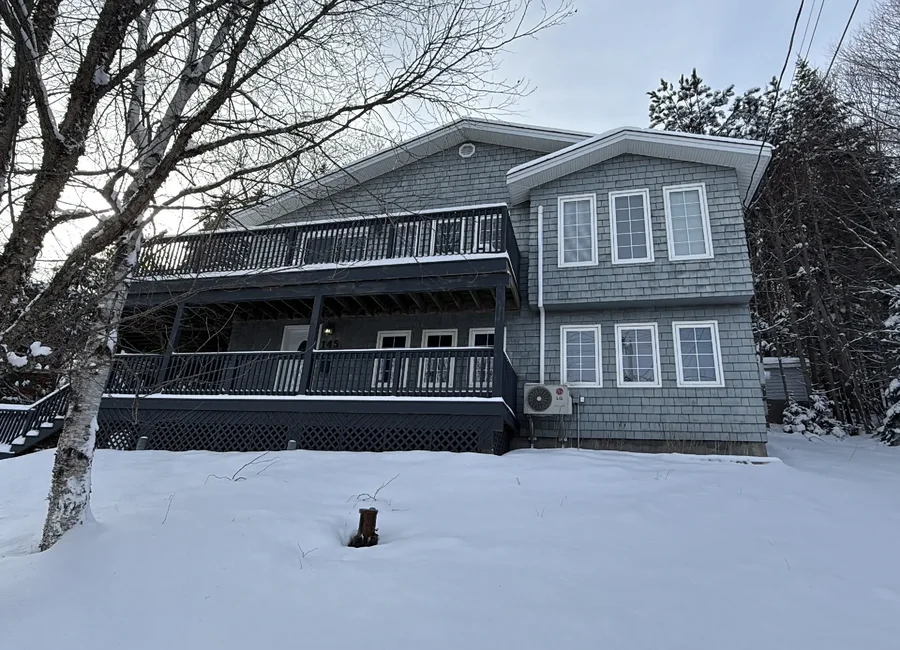
I conduct home inspections year-round in Grand Bay-Westfield, including during winter months when certain conditions become more visible. Winter inspections allow me to assess heat loss patterns, deck structural support under snow load, and how homes handle freeze-thaw cycles. I inspect all accessible components regardless of season, adapting my approach to work safely in New Brunswick winter conditions.
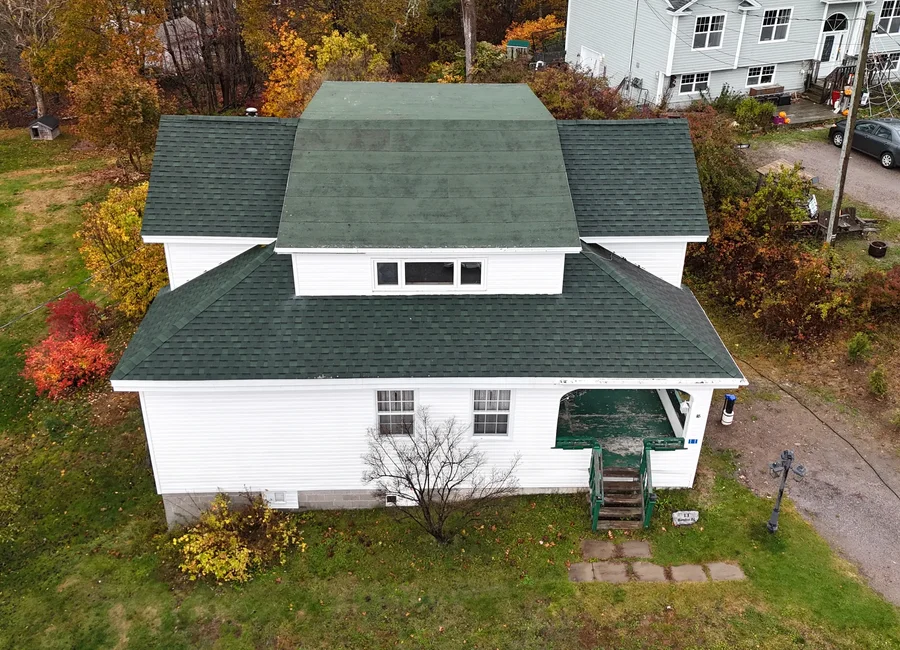
I use drone technology for every home inspection in Grand Bay-Westfield. Aerial inspections provide detailed overhead documentation of roof conditions, including dormer configurations, valley details, and property drainage patterns. Drone inspections allow thorough assessment without the safety risks of walking on roof surfaces, and are included in every inspection I conduct in Grand Bay-Westfield.
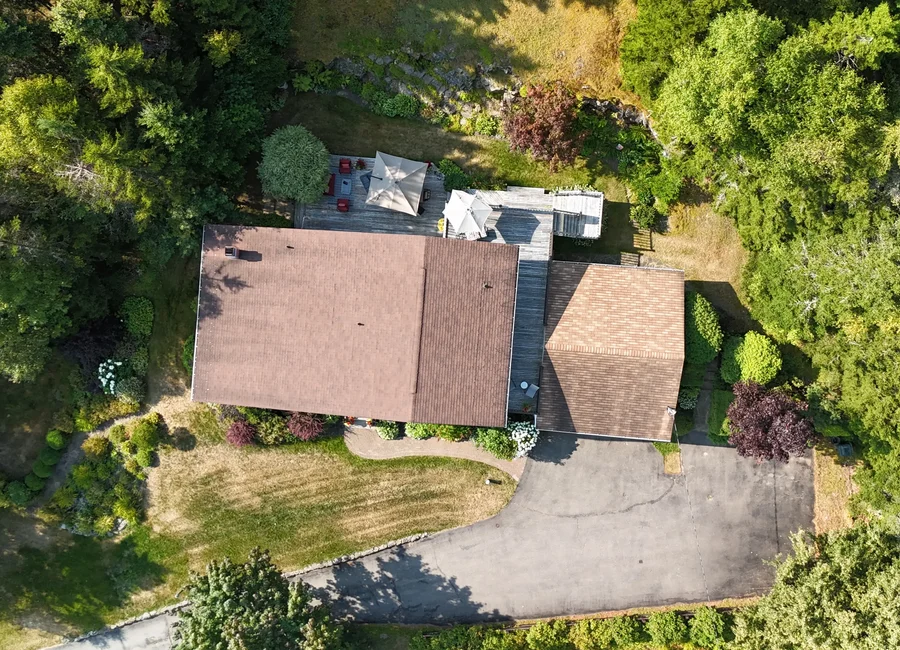
Many homes in Grand Bay-Westfield have been expanded over the years with additions and modifications. I use drone technology to document complex roof configurations and property layouts, paying particular attention to how additions connect to original structures. I examine building envelope transitions, roof valley integration, and structural connections between old and new construction.
The combination of waterfront exposure, aging housing stock, private water and septic, and seasonal-to-permanent conversions creates a unique set of concerns that generic inspection checklists simply don't cover.
River lot properties require assessment of shoreline stability and retaining wall condition, especially after spring flooding or ice damage.
Highly prevalent throughout the area, particularly in Westfield. Many newer developments also use on-site sewage disposal rather than municipal hookups.
Homes built during the late 90s and early 2000s boom often show minor settlement cracks in poured concrete foundations due to local clay-heavy soil.
Winterised cottages may have shallow footings, inadequate insulation, or plumbing not designed for year-round use in cold climates.
When someone tells me a Grand Bay-Westfield property "used to be a cottage," I know exactly what to look for, and it's usually behind the finishes. Each generation of conversion brought different standards. A cottage enclosed in the 1950s has different issues than one upgraded in the 1990s. I look for the telltale signs: foundation walls that don't match the main structure, insulation that stops where the original cottage ended, heating ductwork routed around obstacles, and additions where roof lines create valleys that trap moisture and ice. If you're purchasing a converted property, budget for a comprehensive inspection that includes thermal imaging.
Read reviews from clients I've helped in the Grand Bay-Westfield area.
Worth Every Dollar
"Excellent service, worth every dollar."
Clear and Prioritised
"Not every issue is urgent. Jonathan separates the big-ticket items from the minor maintenance so you know exactly where to focus your attention and your budget."
Whether you're purchasing a converted cottage in Pamdenec, a waterfront property at Brundage Point, a 1970s suburban home in Brandy Point Estates, or new construction in Panoramic Estates, I bring 10+ years of local experience and the technology to inspect it thoroughly.
4.9 rating from 550+ reviews
More than a dozen distinct communities, each originally served by its own Canadian Pacific Railway station. From the Grand Bay village core at the Saint John border to the rural Nerepis Valley. Population: 5,866.
Mixed Era
The original village centre around Murray Street and Thompson Road serves as the commercial and administrative heart of the municipality, bordering Saint John. Housing ranges from pre-war homes to recent infill. Inspections commonly identify aging roof systems, outdated electrical panels in pre-1970s homes, and foundation issues related to variable terrain. The Grand Bay section has the most extensive sewer coverage in the municipality.
Heritage (Pre-1960)
A designated Local Historic Place and the first area in the community developed as a summer destination in the early-to-mid 1800s. Heritage properties feature original stone foundations, early electrical, plaster and lath walls, and roofing patched across generations of river-wind exposure. The scenic views of Long Reach come with direct exposure to seasonal flooding. Critical evaluation points: moisture management, foundation integrity, and quality of winterisation work on seasonal structures.
Cottage Era (1920's-1970's)
Pamdenec is a designated Local Historic Place recognising the Jewish summer community from the 1920s through 1960s. Epworth Park, founded around 1907 by Saint John Methodist ministers, followed a similar seasonal-to-permanent pattern. Many homes retain original cottage features: compact footprints, seasonal-grade foundations, layouts built for summer living. I pay particular attention to insulation adequacy, foundation condition, heating capacity for winter use, and electrical service upgrades.
Waterfront
Brundage Point sits on a peninsula surrounded by the Saint John River on three sides. The Brundage Point River Centre flooded within a year of its 2007 opening, illustrating real risk. Waterfront properties along Brundage Point Road and Hammond Road were directly impacted during the 2018 and 2019 floods, with some roads losing access entirely. Inspections focus on flood damage history, foundation moisture penetration, mould assessment, and submerged mechanical systems.
Rural
The Nerepis area features some of the most rural properties in the municipality, including Craftsman-style homes from the 1920s on multi-acre lots with drilled wells and septic. Inspections almost always involve well water evaluation, septic assessment, and WETT for wood-burning appliances. The Nerepis Valley's groundwater requires treatment for iron and manganese, so water testing is essential.
Waterfront Corridor
Continuous waterfront corridor along the Saint John River, each named for their original CPR railway stations. Housing ranges from early 1900s character homes to mid-century bungalows and later subdivisions. Properties share the flooding and moisture concerns common along the river corridor. The transition from river-side municipal services to inland private systems isn't always clear from a listing. I confirm servicing status during every inspection.
1970's-1990's
Suburban-style development that expanded the community beyond its cottage roots during the 1970s and 1980s. Beverly Hills and Valley View Estates are characterised by steep hills and dense woods. Homes commonly feature concrete block or poured foundations, fibreglass batt insulation, original 100-amp panels, and oil-fired heating approaching end of life. The steep terrain means drainage patterns, retaining walls, and foundation stability on sloped lots get close attention.
2010's-Present
The newest chapter in Grand Bay-Westfield housing. Modern builds should feature current building code standards including improved insulation, energy-efficient windows, and potentially radon mitigation rough-ins. Even new construction needs inspection. I verify code requirements were properly executed, check for construction deficiencies not visible once finishes are applied, and ensure well and septic installations meet current standards. CMHC Housing Accelerator funding supports 160+ new units.
Grand Bay-Westfield's geology, shallow soil cover over fractured volcanic and granite bedrock, creates conditions where radon can accumulate in basements and lower levels. Health Canada data shows approximately 12% of homes in the area test above the 200 Bq/m³ guideline, meaning roughly 1 in 8 homes has elevated radon. Every home should be tested regardless of age. I offer radon testing as a standalone service or paired with your home inspection.
Grand Bay-Westfield sits between two of my most active service areas. If you're also exploring properties in these neighbouring communities, I've got you covered.
Grand Bay-Westfield has a long history of seasonal cottages, particularly in Pamdenec, Westfield Beach, and Epworth Park. Many of these properties have been converted to year-round homes over the decades. The quality of that conversion varies widely. During your home inspection, I look at whether the foundation is adequate for year-round use, if the insulation meets current standards, whether the plumbing was upgraded for winter, and if the electrical panel supports a full-time household.
That is correct. Every property in Grand Bay-Westfield is on a private well. The local geology of shallow soil over fractured bedrock means well water quality can vary significantly, with iron and manganese being common concerns. I recommend water testing for every Grand Bay-Westfield home inspection so you understand what you are working with from day one.
The 2018 flood reached 5.76 metres and impacted over 30 streets, isolating roughly 800 households. Areas like Brundage Point, Hillandale, and sections of Westfield Beach were among the hardest hit. I look for signs of past flood damage, check drainage and grading, and assess whether a backwater valve has been installed on properties near the river.
Over 50% of Grand Bay-Westfield properties are on septic systems, and the shallow bedrock in some areas means raised bed systems are common. Properties near the river also face the risk of flood water compromising septic function. I evaluate the functionality at fixtures and exterior fields. I recommend homes with a septic system have them evaluated by a qualified specialist as part of their conditions.
Yes. Grand Bay-Westfield is seeing new development through the CMHC Housing Accelerator Fund, with 160+ new units planned. A new construction inspection focuses on whether the home was built to current code, including foundation quality, grading, HVAC installation, and overall finish work. Catching issues before your warranty period ends can save you significant time and money.
Find My Package
Every home in Southern New Brunswick has its own story. Age, heating, layout, hidden systems all matter. Answer four quick questions and I will recommend the package that fits.
4.9 rating from 550+ reviews
Free to use. No email needed to see your recommendation.
Waterfront homes, cottage conversions, and rural properties along the Saint John River. Well and septic, thermal imaging, drones included.