The Hidden Danger
Why Radon Testing Matters in New Brunswick
Radon is a radioactive gas that comes from natural uranium decay in soil. It's invisible, odourless, and the leading cause of lung cancer in Canada.
Leading Cause of lung cancer in Canada (non-smokers)
3,000+ Canadians die every year from radon-caused lung cancer
4 of 14 Highest-risk health regions in Canada are in New Brunswick
23-44% Of homes in some NB regions exceed safety guidelines
Health Canada Radon Health Guidelines →
Why New Brunswick Homes Are at Higher Risk
New Brunswick's geology is a significant factor. The province sits on rock formations that contain natural uranium, which breaks down into radon gas over time. This gas moves up through soil and enters homes through foundation cracks, gaps around pipes, sump pits, and floor drains.
Homes in Southern New Brunswick face additional risk factors.
Older foundations
Many homes in Saint John, Hampton, and Sussex were built with stone, block, or poured concrete foundations that develop cracks and gaps over time. These entry points allow radon to seep in more easily than in newer, sealed construction.
Basement living space
Finished basements are common throughout the region. A finished basement where your family spends time is the area most likely to have elevated radon levels, and where exposure matters most.
Heating season
During New Brunswick's long winters, homes are sealed tight for months. Reduced ventilation allows radon to accumulate indoors. This is why Health Canada recommends testing during the heating season for the most accurate results.
No visible warning signs
Radon is colourless, odourless, and tasteless. A home with elevated radon looks and smells exactly the same as one with safe levels. The only way to know is to test.

Same Day Results
My certified in-house lab means you get results the same day I collect your device. No waiting weeks.

Professional Equipment
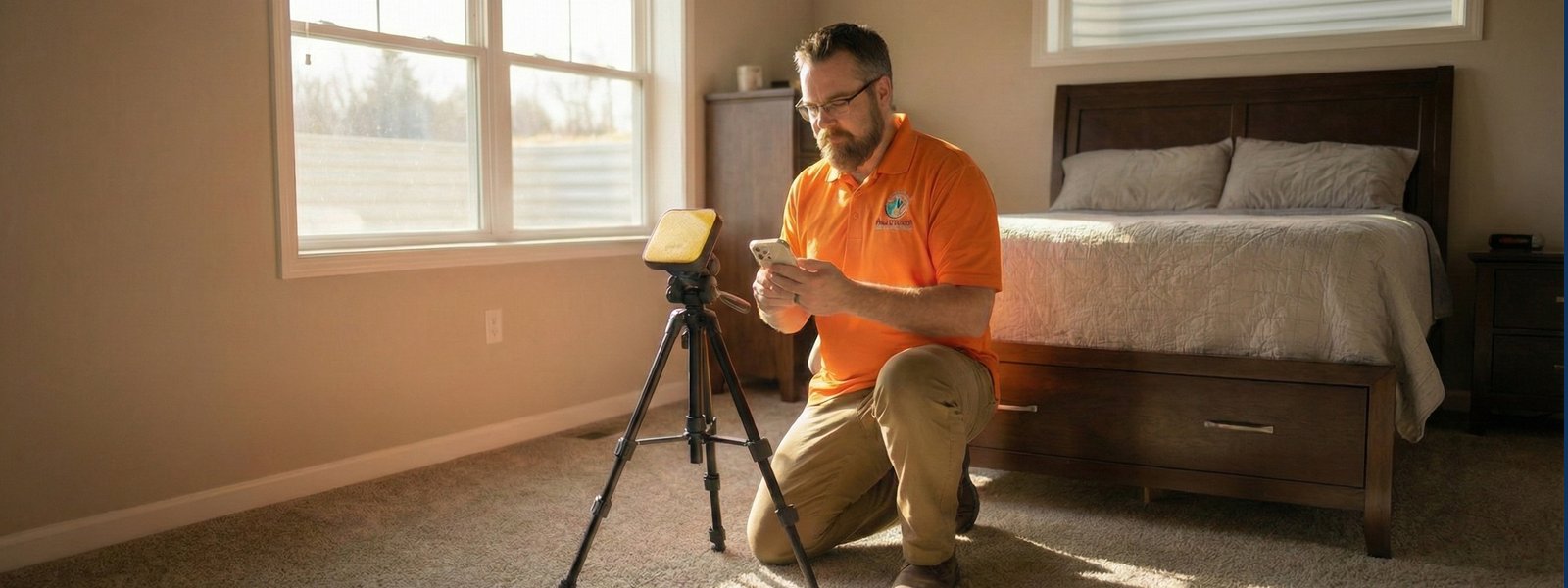
Airthings Pro and E-Perm devices provide accurate, reliable measurements you can trust.

Clear Recommendations
Easy to understand reports with actionable next steps, not confusing technical jargon.

C-NRPP Certified
Dual certification as Measurement Professional and Analysis Laboratory.

Local Expertise
I understand New Brunswick's unique radon landscape and building characteristics.

Trusted by Realtors
Licensed NBREA affiliate who works seamlessly with your transaction timeline.
See Where I've Tested
62 of my own radon tests across southern New Brunswick since 2020, on one map, with what I found in each area. It's a record of where I've tested, not a rating of any area.
Understanding Your Radon Results
Your report will include a clear radon level measured in Becquerels per cubic metre (Bq/m³), along with my recommendation based on Health Canada's guidelines.
Curious where I've tested? My radon map shows every test I've done across southern New Brunswick since 2020.
Below 200 Bq/m³
Within Health Canada's guideline. No action required. Consider retesting in 5 years or after major renovations.
200-600 Bq/m³
Above guideline. Health Canada advises reducing it within 1 year. I can connect you with certified C-NRPP mitigation professionals.
Above 600 Bq/m³
Significantly above guideline. Health Canada advises acting sooner than 1 year. Priority action advised.
If your levels are elevated, the fix is straightforward. A certified mitigation professional installs a sub-slab depressurization system that vents radon gas from beneath your foundation to the outside. Most residential mitigation systems cost about the same as a new hot water heater, and they reduce radon levels by up to 90% or more.
I do not perform mitigation work. This keeps my testing independent and free from any conflict of interest. If you need mitigation, I will connect you with certified C-NRPP mitigation professionals who serve Southern New Brunswick.
Attention to Detail
"Thorough home inspection with attention to details. Highly recommend East Coast Home Inspection Ltd."
C
Cody H
Saint John NB · May 2026
Home Inspection · Sewer Scope · Radon
Prompt and Reliable
"Jon was prompt with communication, including the radon report. We were happy with his service and would recommend him for radon testing."
B
Barbara C
Rothesay NB · April 2025
Ready to Test Your Home?
Don't wait to find out if your family is at risk. Testing is fast, affordable, and could save lives. Serving Saint John, Hampton, Rothesay, Quispamsis, Sussex, and surrounding areas.
Radon Screening Assessment for Real Estate
4-7 days
Buying a home and need radon information before closing? The Radon Screening Assessment was developed by CARST (the Canadian Association of Radon Scientists and Technologists) specifically for real estate transactions where a long-term test is not practical within the sale timeline. The test runs for a minimum of 4 days under closed-house conditions and is performed by a C-NRPP certified measurement professional.
Results are reported using a colour-coded system developed by CARST:
- Green 75 Bq/m³ or less during heating season (50 Bq/m³ or less outside heating season). Lower likelihood that the annual average exceeds Health Canada's 200 Bq/m³ guideline. A long-term follow-up test is still required after you take possession.
- Yellow Greater than 75 Bq/m³ during heating season (greater than 50 Bq/m³ outside heating season) up to 400 Bq/m³. Higher likelihood that the annual average exceeds the guideline. Budget for potential mitigation costs during negotiations.
- Red Greater than 400 Bq/m³. Strong likelihood that the annual average exceeds the guideline. Mitigation costs should be factored into the purchase.
Source: CARST Real Estate Screening Assessment Guideline →
Short-Term Test
Less than 90 days
For homeowners who want results sooner than a full long-term test allows. CARST and C-NRPP define a short-term test as any radon measurement under 90 days. I deploy the device for a minimum of 7 days under closed-house conditions. A longer duration produces a more representative reading.
Important: A radon test shorter than 48 hours is never acceptable. Some non-certified companies offer 1-hour testing, and both CARST and C-NRPP are clear that this does not meet any recognised Canadian standard.
Short-term tests should always be followed up with a long-term test, as radon levels fluctuate with weather, wind, and barometric pressure. A short-term result provides a snapshot, not a complete picture of annual exposure.
Source: CARST, Take Action on Radon →
The most accurate way to understand your home's radon levels. Health Canada, CARST, and C-NRPP all recommend basing a decision to mitigate on a long-term radon measurement conducted during the heating season while the home is occupied. Testing during the heating season (October through April) captures the period when radon levels are typically highest because homes are sealed and indoor air is warmer than surrounding soil, which pulls more radon gas inside.
University of Calgary research cited by CARST found that 5-day tests predicted 90+ day results 80% of the time, but accuracy dropped significantly in summer months. This is why the long-term test during heating season remains the gold standard for making a mitigation decision.
Source: CARST, Take Action on Radon →